The first edition of the Moldova Security Forum was attended by more than 500 participants from 28 countries
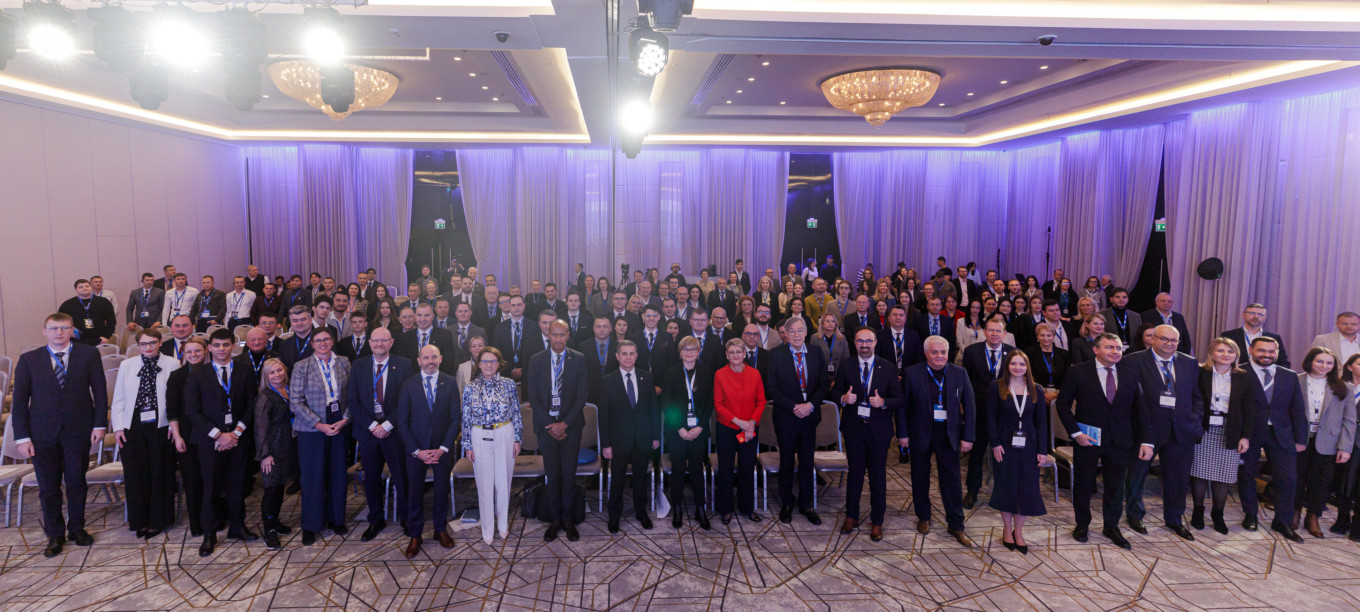
The Institute for European Policies and Reforms, the Konrad Adenauer Foundation Office in the Republic of Moldova and NATO Liaison Office in Moldova organized on 19 – 20 November 2024 the first edition of the Moldova Security Forum (#MSF).
Moldova Security Forum is a premier regional event that addresses crucial national and regional security challenges, focusing on resilience, disinformation, cyber threats, artificial intelligence, and hybrid threats. The forum brought together high-level officials, distinguished policymakers, academics, representatives of international organizations, and experts to foster meaningful dialogue and collaboration.
Photo gallery

In his opening speech, Igor Grosu, Speaker of the Parliament of the Republic of Moldova, mentioned: “In recent years, Moldova has been the target of unprecedented hybrid attacks, which have intensified this autumn in the context of the presidential elections and the referendum on European Integration. Criminal groups wanted to come to power at all costs. Their target was to buy 300 000 votes. Our institutions have discovered 150 000 cases of vote buying. It was a miserable attack on our sovereignty. However, Moldova resisted. Our citizens have demonstrated an exemplary mobilization, protecting democracy and the European path. Another lesson we have learned is that we have the duty to modernize and develop the national army, to improve our capabilities and to ensure that our soldiers have living and service conditions at the level they deserve. Our commitment is to ensure a decent professional and social status for all those who serve the country with devotion.“
Furthemore, Justin Suni, Acting Head of the NATO Liaison Office in Moldova, stressed: “NATO and its allies deeply value our long-standing partnership with them. In Washington, allies welcomed Moldova’s efforts to continue its diplomatic reforms to enhance its European impact. This year, we mark NATO’s 75th anniversary. We also celebrate 30 years of NATO-Moldova cooperation, a partnership firmly based on protecting our military freedom rights, safeguarding justice, and promoting peace through democracy. This decades-long partnership has fully supported Moldova’s territorial integrity and respected its constitutional neutrality. With Moldova in the driver’s seat, NATO will continue to respond to the priorities set out by our partner. This brings us to why we’re gathered here today.“
“Despite all the destruction, killings, and war crimes we have seen, we are also showing that Ukraine’s security is the region’s security; it’s Europe’s security. The war in Ukraine shows that imperialistic ambitions are on the rise and that there are also new threats to democracy. These are times when someone needs to know you can trust a friend, a partner, and a devoted ally. In these uncertain times, the significance of our security partnership for Moldova and Ukraine is multilayered. If you manage to set up a new structure for advancing security communication, your security gets stepped up.
But coming to hard security, from 2021 to 2024, the European Peace Facility’s support to the modern Armed Forces has reached 137 million euros, making Moldova the second largest recipient of bilateral support under this instrument. And this is what we intend to continue. The EU Partnership Mission has joined forces with Moldovan authorities to face foreign interference, including an unprecedented attempt to undermine the electoral process during the recent presidential elections and the EU referendum. The signature of the Security and Defense Partnership in May has taken our cooperation to a qualitatively new strategic level.” said Jānis Mažeiks, Ambassador of the European Union to Moldova.
Brigitta Triebel, Director, Konrad Adenauer Foundation Republic of Moldova, mentioned: “Democracy and freedom need security and social resilience against authoritarian development, disinformation, and propaganda. We also need sustainable responses to risks such as climate change and social inequality. With our projects, whether connected to the national security strategy or as the co-organizers of this conference, we support a democratic and self-determined Republic of Moldova integrated into the European Union. We need only look at the situation in Ukraine to see how important freedom and security are to us as Europeans. This is why we, as a foundation founded to promote democracy first in Germany and abroad, have focused on the issue of security here in Moldova.“
At the same time, Iulian Groza, Executive Director of IPRE, mentioned: “This forum offers a unique opportunity to address these challenges head-on. Over the next two days, we’ll discuss NATO’s evolving partnerships, the role of the EU as a security actor and the multidimensional nature of hybrid threats. These discussions will help us identify solutions to increase security, resilience and alignment of Moldova with the European community. Russia carried out its most devastating airstrike on Ukraine on November 17, targeting critical infrastructure and deepening the humanitarian crisis as winter approaches, underscoring the urgency to build the resilience of countries in our region Moldova’s National Security Strategy, approved in 2023, clearly identifies Russia as the main source of these hybrid threats, including disinformation, political manipulation and propaganda campaigns.“
More details, including the video recording of the Forum, are available on the official website securityforum.md. The statements of #MSF2024 speakers can also be found on the social media pages of the Konrad Adenauer Foundation Office in the Republic of Moldova (KAS), the NATO Liaison Office in the Republic of Moldova and IPRE.
The Moldova Security Forum 2024 was organized by the Konrad Adenauer Foundation Office in the Republic of Moldova, the NATO Liaison Office in the Republic of Moldova and the Institute for European Policies and Reforms (IPRE). The event benefited from the partnerships and support of the International Republican Institute (IRI), the Soros Foundation Moldova, the European Union Partnership Mission in the Republic of Moldova (EUPM), the Tony Blair Institute (TBI), the Platform for Security and Defense Initiatives (PISA), the Geneva Security Sector Governance Center (DCAF), the Geneva Center for Security Policy (GCSP), the New Strategy Center (Bucharest), New Europe Center (Kyiv), the Aspen Institute, and other national and international organizations.